
AI companies, as "Central Banks of Intelligence" fueling the hyperbolic valuation!

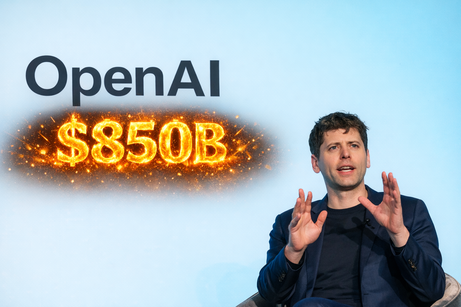
The eye-popping of AI giants, like OpenAI (valued at $852B as of March 2026), NVIDIA, Microsoft, Google, etc, are often misunderstood. While public markets look at monthly subscription revenue ($20/month for a "Pro" plan), venture capitalists and institutional investors are looking at something far more valuable: the Data Arbitrage.
OpenAI’s $852B valuation is a massive bet on future dominance rather than current profits. Despite a soaring $25B revenue run-rate, the company faces a staggering $17B annual cash burn due to immense compute costs. Trading at 34x revenue, triple the Big Tech average, the valuation reflects the "Data Flywheel" effect: using proprietary corporate deposits to build a monopoly on intelligence. Profitability isn't expected until 2030.
The true "fee" these companies collect isn't the cash in their bank accounts; it is the proprietary corporate data that businesses "deposit" into their systems every second.
1. The "Subscription" is a Trojan Horse
From an investor's perspective, the monthly subscription fee is almost irrelevant—it barely covers the massive electricity and "compute" costs required to run the models. The real transaction is the data transfer.
When a Fortune 500 company integrates an LLM into its workflow, it begins feeding the model its most guarded secrets: legal strategies, supply chain efficiencies, internal codebases, and customer behaviors. This is Proprietary Big Data, the kind of high-quality, "clean" information that does not exist on the public internet. By "depositing" this data to get a productivity boost, corporations are essentially handing over the "refined uranium" that AI companies need to power their next generation of models.
2. Data as the "New Oil" and "New Capital"
In the 20th century, companies were valued based on physical assets. In the AI era, they are valued on Intelligence Assets.
The Refinement Process: AI companies use these corporate deposits to train "vertical" models. A model trained on a thousand law firms' private documents becomes the world’s most valuable lawyer.
The Valuation Moat: This creates an insurmountable "moat." A new startup can raise a billion dollars, but it cannot buy 20 years of a global bank’s internal transaction logic. That data is "locked" inside the first AI company that the bank signed with.
3. The "Stickiness" of Intellectual Property
These valuations reflect a transition from Software-as-a-Service (SaaS) to Knowledge-as-a-Service. Once a corporation’s proprietary data is the "fuel" for an AI, that AI becomes the company's "operating system."
High Switching Costs: If a company tries to leave, they lose the "customized intelligence" built on their own data.
The Magnet Effect: As the AI becomes smarter by consuming the data of the "early adopters," it becomes more attractive to the rest of the market. This creates a winner-take-all monopoly where the most "data-rich" company wins.
4. Summary: The Intelligence Central Bank
In short, Big AI companies are valued like Central Banks of Intelligence. They don’t just provide a tool; they provide a vault where corporations store their knowledge. The AI company then uses the collective "interest" on that knowledge (the patterns learned from that data) to build a product so advanced that it becomes a mandatory tax on the rest of the global economy.
Investors aren't betting on a $20/month app; they are betting on the entity that owns the collective memory of the corporate world.
Does this change how you view the "privacy vs. productivity" trade-off for your own business?


Comments