
The AI Bubble: Capex, Circular Financing, Unsustainable Economics


The rapid escalation of capital expenditure on artificial intelligence infrastructure has produced the largest investment surge in modern history. Yet the underlying economics remain detached from demonstrated returns. Hyperscalers and AI labs are committing trillions in spending while generating limited, often unprofitable revenue. Circular financing, off-balance-sheet obligations, and intensifying competition from Chinese open-source models have created a structure vulnerable to abrupt repricing. The evidence points to a classic bubble: asset prices and capital commitments far exceed the cash flows and productivity gains that can realistically support them.
Off-Balance-Sheet Commitments and the Scale of Hidden Obligations
In mid-2026, a Nikkei study revealed that the five largest U.S. technology companies were carrying approximately $1.65 trillion in debt-like obligations that do not appear as liabilities on their balance sheets. These consist primarily of long-term purchase agreements for GPUs and multi-year leases on data centers that have not yet entered service. Under standard accounting rules, undelivered goods and unactivated facilities are disclosed in footnotes rather than recorded as on-balance-sheet debt. The Financial Times subsequently identified an additional $50 billion in Nvidia leases for a single Texas data center filled with its own chips, commitments previously unknown to the market.
Subsequent earnings reports showed three of these firms alone signing nearly $900 billion in new AI-related commitments in a single quarter, rendering the $1.65 trillion figure already outdated. Meta alone announced $233 billion in fresh commitments, of which $96 billion were leases that will migrate onto the balance sheet only as facilities become operational.

When large technology companies raise capital simultaneously through every available channel, record levels of debt, equity, and convertible instruments, the signal lies less in the specific instruments chosen than in the overall scale of the fundraising. Such aggressive multi-channel capital raising is typically undertaken only when management believes the projected returns justify retaining full ownership upside for existing shareholders. Alphabet’s $85 billion equity raise in 2026, the largest in corporate history and anchored by a $10 billion commitment from Berkshire Hathaway at a reported 6 percent discount to market, is one clear example. These raises make the scale of AI-related spending highly visible rather than concealed.
Much of the associated obligation is temporary in accounting terms. Leases that have not yet commenced will migrate onto the balance sheet as liabilities once the data centers become operational; this is primarily a timing difference. Meta’s $233 billion in new commitments in a single recent quarter included $96 billion of such leases. Purchase commitments, for their part, largely convert into owned chips and facilities. The more durable complexity arises from joint ventures and purpose-built off-balance-sheet vehicles deliberately structured to remain outside the primary balance sheet.
These arrangements resemble the special-purpose vehicles used by Enron to keep debt off the primary balance sheet, though they operate within current accounting standards rather than through outright fraud. The parallel to 2008 is structural rather than criminal: large, opaque obligations whose true scale becomes visible only under stress. Credit-default-swap-like guarantees and vendor financing further concentrate risk. When the counterparties are interdependent, a failure in one link transmits losses across the chain.
Circular Financing and Vendor Backstops
A substantial share of reported AI-related revenue is circular. OpenAI and Anthropic together account for the majority of demand at the largest AI infrastructure providers. Analyst estimates indicate that OpenAI and Anthropic will contribute roughly 27 percent of Google Cloud revenue in 2026 and more than 48 percent in 2027; equivalent figures for AWS run to 13–18 percent. In absolute terms this implies $50 billion of cloud revenue in 2026 and more than $124 billion in 2027 flowing from two entities that themselves remain deeply unprofitable.
Nvidia has proposed backstopping $250 billion of OpenAI compute costs while simultaneously financing approximately $350 billion of GPU purchases for the same facilities. Google has agreed to guarantee roughly $35 billion of Anthropic lease payments. SoftBank has committed $65 billion to OpenAI and arranged a $40 billion bridge loan to fund the investment. These structures function as classic vendor financing: the supplier lends the customer the money required to purchase its own product. While such arrangements have historical precedent in telecommunications and aerospace, the absolute scale, hundreds of billions, and the concentration of both supply and demand among a handful of parties elevate systemic risk. Nvidia’s credit-default-swap spreads widened sharply on announcement of the largest of these deals, indicating that debt markets themselves price the concentration risk.
Weak Links: OpenAI and Oracle
OpenAI and Oracle represent particularly weak links. OpenAI remains heavily loss-making, dependent on continuous external capital, and the largest single consumer of AI compute; its price cuts (up to 80% on certain models) and delayed IPO plans signal pressure rather than durable unit economics.
Oracle’s aggressive data-center commitments, including projects linked to OpenAI, have driven rapid growth in both on- and off-balance-sheet leverage and contributed to rating downgrades. A pullback by either, or by any major hyperscaler on CapEx, would cascade through the chain of GPU orders, memory suppliers, construction, and debt markets.
Unit Economics, Asset Lifetimes, and Capital Intensity
AI companies have spent an estimated $2.4 trillion on infrastructure while generating roughly $50 billion in annual revenue. GPUs and the data centers that house them are replaced every two to three years because successive generations are deliberately non-backward-compatible in power, cooling, and networking requirements. High-bandwidth memory prices are projected to rise approximately 90 percent by 2027, driven by limited fab capacity and concentrated demand from Nvidia (itself accounting for roughly 65 percent of HBM consumption).
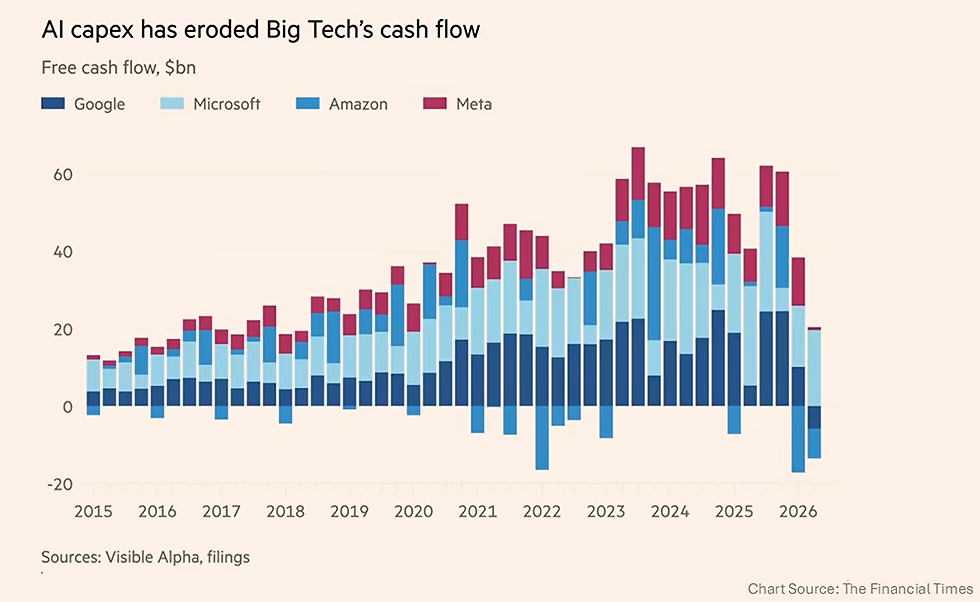
Unit economics remain negative: each additional customer and each incremental token processed increases losses rather than margins. Hyperscalers have already become net cash borrowers; their combined free cash flow recently fell to a decade low of $7 billion, with Alphabet turning cash-negative for the first time since its IPO. Amazon’s $25 billion bond issue attracted only 1.6 times subscription, well below the multi-fold oversubscription typical for investment-grade paper, signaling waning appetite among fixed-income investors.
The Economist calculates that the current build-out trajectory would require approximately $2.5 trillion in annual AI-related revenue to service the capital invested, more than the entire global technology sector currently earns from all products and services. Observed adoption data fall far short of that threshold.
A Bank of England study found the average American executive spends about 100 minutes per week using AI tools. Ramp’s analysis of actual corporate spending showed a median of $10.66 per employee per month. Nine out of ten executives surveyed reported no measurable productivity improvement over three years.
Chinese Open-Source Models and Price Compression
Chinese open-weight models have repeatedly undercut Western commercial offerings on both performance-per-dollar and absolute price. Each successive release has compressed the pricing power of proprietary models. OpenAI’s aggressive price reductions in mid-2025 occurred immediately after competitive releases that further eroded margins. Because inference costs scale with usage and remaining fixed costs are enormous, sustained price pressure accelerates cash burn rather than expanding profitable volume.
Market Valuation and the Absence of Proven Returns
The AI trade has delivered substantial equity returns, particularly for semiconductor suppliers. Those returns, however, rest on the continuation of debt-financed capital expenditure rather than on demonstrated enterprise value creation. Public companies that once disclosed AI-related revenue have in several cases ceased doing so, an omission typically associated with disappointing results. SpaceX’s prospectus attributed 93 percent of a claimed $28.5 trillion total addressable market to AI and related applications, illustrating the degree to which speculative narratives have displaced conventional valuation discipline.
Facing the reality of the numbers
The arithmetic is already decisive. Cumulative AI infrastructure spending has reached approximately $2.4 trillion while annual revenue remains near $50 billion. Off-balance-sheet commitments stand at $1.65 trillion and rising, with nearly $900 billion added by three firms in a single quarter. OpenAI and Anthropic alone carry more than $1.1 trillion in compute obligations. Hyperscalers have shifted from cash-rich to net borrowers; their combined free cash flow recently fell to a decade low of $7 billion, and Amazon’s $25 billion bond issue attracted only 1.6 times subscription. Unit economics continue to worsen with scale, asset lives remain two to three years, and high-bandwidth memory prices are projected to rise nearly 90 percent by 2027. Measured usage—an average of 100 minutes per executive per week and a median corporate spend of $10.66 per employee per month—cannot support the $2.5 trillion in annual AI revenue required to service the capital already deployed.
When the first major hyperscaler reduces AI capital expenditure, the circular flows that currently sustain cloud growth, GPU orders, and secondary financing will reverse at once. OpenAI, the most leveraged data-center vehicles, and the vendor-financing chains that depend on them form the weakest links.
The market will then confront, in a compressed timeframe, the full weight of obligations that have been disclosed in footnotes rather than on balance sheets. The trajectory is no longer a question of timing; it is a question of when the numbers force recognition.
P.S.
The video at the top of this post shows the incident that took place at Computex 2026 in Taipei during a live presentation by a Qualcomm partner.
During a keynote showcase, a prototype humanoid robot, specifically Qualcom's partner NEURA Robotics' 4NE-1, walked onto the stage carrying a tray displaying Qualcomm's new Dragonwing IQ10 AI robotics reference chip (which claims 700 TOPS of processing power). After delivering the chip box to the presenter, the robot stood beside him. Moments into the speech, the robot suddenly buckled, made a mechanical screeching sound, and collapsed into a heap on the stage.
The Stage Reaction
The video went viral on social media largely due to what happened next:
The Presenter: Continued the presentation without missing a beat, ignoring the collapsed machine.
The Stagehands: Swiftly rushed out to cover the fallen robot in a purple/black cloth before carrying it offstage.
Qualcomm's Response
Qualcomm released an official statement explaining that the incident was a safety feature rather than an unmitigated hardware crash:
"Live demos involve risk. At Computex in Taipei, a brief communication glitch triggered a fault in the prototype humanoid and initiated a controlled shutdown. The robot performed its designed 'safe-collapse' sequence, lowering itself to its knees to protect the environment around it. The safety systems worked as intended."
While the glitch made for awkward live optics, Qualcomm maintained that the controlled fall demonstrated effective fail-safe programming during hardware or communication timeouts.
The exact cause has not been disclosed but the incident serves as a reminder that even cutting-edge AI hardware can encounter unexpected technical issues during live demos.


Comments